Franklin County Engineer Facebook Feed

Franklin County Engineer

As a local public works agency headquartered in Columbus, Ohio, the Franklin County Engineer's Office is responsible for the maintenance and construction of 271 miles of county roadway and 351 county bridges, as well as upkeep of all county ditches, drains, retention basins, and other storm water facilities within the right-of-way of county roads in unincorporated areas. To meet the continuing development and infrastructure needs of Franklin County, the Engineer's Office utilizes the latest technologies for determining and maintaining roadway centerlines and boundaries; retracing and setting new monuments for original public land surveys; preparing geographic information system mapping for real estate tax assessments; and establishing precise countywide horizontal and vertical control to maintain uniformity in construction, surveying, and mapping.
Franklin County Engineer
#TeamFCEO had an absolute blast yesterday at Prairie Township’s Trick-or-Treat Trail event! Beautiful weather, an outstanding turnout, and plenty of Halloween spirit made for a fantastic day! We enjoyed seeing all the creative costumes, sharing smiles, and connecting with so many wonderful families. Events like this are a great reminder of how much we enjoy being part of the community we serve! A big thank you to Prairie Township, Franklin County, OH, for hosting such a fun-filled event, and to everyone who stopped by to say hello!
Franklin County Engineer
The Genessee Avenue Drainage Project is complete! This improvement strengthens local drainage infrastructure and connects to the existing Earl Avenue storm system. Thank you to everyone who helped bring this project to completion.
Franklin County Engineer
Teen Driver Safety Week is a reminder that safe driving habits start with all of us. Keep talking about safe choices, model responsible driving, and help young drivers build skills that last a lifetime.

Learn more at trafficsafetymarketing.gov.
Franklin County Engineer
Notice to Contractors: We are accepting bids on the Johnstown Road at 17th Avenue and I-670EB Off-ramp Improvements Project. Visit: https://www.bidexpress.com/solicitations for more information.
Franklin County Engineer
We're looking forward to attending the 2026 Ohio Transportation Engineering Conference (OTEC) tomorrow and Wednesday! This year's theme, “OTEC @ 80: Honoring Legacy, While Engineering the Future,” sets the stage for two days of collaboration, innovation, and meaningful conversations about Ohio's transportation future. We're especially proud of our own Mike Andrako, P.E., W. Fritz Crosier, P.E., and Ed Herrick, P.E., who will be sharing their expertise as conference presenters! Attending OTEC? Be sure to check out their sessions! #OTEC2026
Franklin County Engineer
Today is the day! Join us 4-8 p.m. at Fortress Obetz for Touch-And-Ride-A-Truck! Explore big trucks and equipment, meet the crews, and bring diapers or wipes to support the Columbus Diaper Coalition. Bring the family and join the fun, rain or shine!
Franklin County Engineer's Office
970 DUBLIN ROAD
COLUMBUS, OHIO 43215
(614) 525-3030
fracoeng@franklincountyengineer.org

Follow Us

Top
 

Roundabouts

Roundabouts

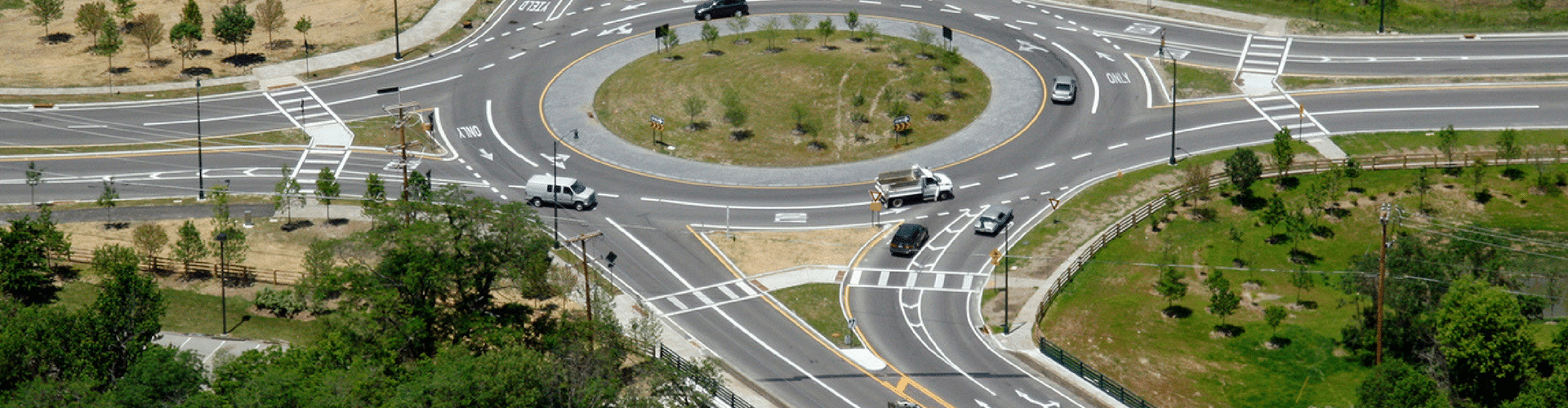
We want everyone to feel confident, be secure, and to “keep in the loop” with their safe driving practices as they travel modern roundabouts.

To help the public become more familiar with how to drive a roundabout, we’ve created this user guide that shows the various traffic patterns, rules, and general instructions that we hope everyone will follow.

View videos

What is a modern roundabout?

It is a one-way circular intersection with yield control of all entering traffic. Vehicles circulate counter-clockwise at speeds around 20 M.P.H. The lane use is very similar to a typical four-way intersection except for a slight circular adjustment.

Seven rules for safely driving roundabouts:
  • Slow down
  • Get in the correct lane before entering the roundabout:
    • Use the right lane for turning right or going straight (same as a conventional intersection).
    • Use the left lane for going straight or turning left (same as a conventional intersection).
    • Use the left lane to make a U turn.
  • Look for and yield to pedestrians in the crosswalk before entering the roundabout.
  • Yield to all circulating traffic when entering the roundabout. Even if there are two lanes in the roundabout, yield to both.
  • Drive counter-clockwise, following the one-way traffic pattern.
  • Do not change lanes within the roundabout.
  • Look for and yield to pedestrians in the crosswalk upon exiting the roundabout.
Why build a modern roundabout instead of a typical intersection?

Modern roundabouts are safer than traditional intersections, which have more conflict points and operate at higher speeds.

Studies have shown that roundabouts provide nearly an 80 percent reduction in injury accidents since the circular layout dramatically reduces the likeliness of head-on or broadside collisions.

What are some of the other benefits of modern roundabouts?
  • Traffic from all directions is slowed down to the same speed, giving motorists more time to judge and react to traffic.
  • Shorter and better-planned crosswalks are located away from the busy intersection.
  • There is a reduction in pollution and fuel use since there is less idle time for motorists.
  • Slower speeds and fewer stops and starts result in less traffic noise.
  • There are no expensive traffic signals to install or maintain.