




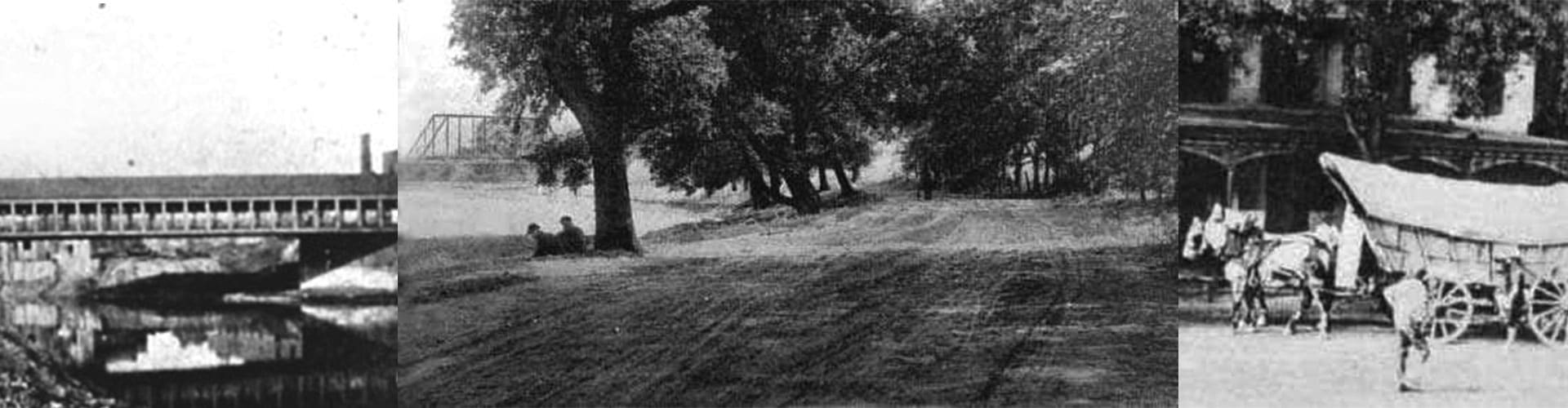
Surveyor’s Journal Entry Nineteen
Public Health Issues Intensify the Need for Open Land and Preservation
The calls for more open land by a growing populace were intensified by Franklin County’s first major outbreak of “fever” in 1823. Unaware of the causes of the pestilence, many sought to relocate from the urban areas of Columbus and Franklinton where most of the victims resided.
Those who succumbed to illness included Deputy Surveyor and Franklinton founder Lucas Sullivant and Columbus proprietor John Kerr in 1823, and Franklin County Surveyor Joseph Vance in 1824.
Throughout the 1800s, Malaria, Cholera, and Typhoid Fever claimed thousands of lives in Franklin County and caused more than a third of the population to become displaced in the wake of seasonal epidemics.
Overwhelming use of the city’s North Cemetery, at the site of today’s North Market, lead to the establishment of Green Lawn Cemetery, in 1849, on the 300-acre Miner Family farm located 2.5 miles southwest of the Statehouse. The park-like setting was created by Howard Daniels (nationally renowned landscape designer) and Joseph Sullivant (Lucas Sullivant’s youngest son, educator, and philanthropist) who was the President of the Green Lawn Cemetery Association.
Dr. Lincoln Goodale (the county’s first physician, noted businessman, and brother-in-law of James Kilbourne) was an early advocate for the preservation of open space that would benefit public health. In response to the right-of-way demands of the Columbus and Xenia Railroad, the area’s first train service, Dr. Goodale deeded 44 acres of downtown land to Columbus, in 1851, to create Goodale Park.
East of downtown, the Franklin County Agricultural Society purchased 88 acres of pasture land along Broad Street, in 1852, for the establishment of Franklin Park. It was the site of the Franklin County Fair until 1886 and the Ohio State Fair from 1874 to 1885. The Franklin Park Conservatory was built there in 1895.
In 1867, the City of Columbus purchased 23 acres in the German Village neighborhood from David Deshler (carpenter, entrepreneur, and banker), his son William Deshler (businessman and philanthropist), and Allen G. Thurman (Lawyer, Ohio Supreme Court Justice, and U.S. Senator) for $15,000 to create City Park. The land, previously owned by Francis Stewart (County Sheriff, businessman, and philanthropist), was one of the earliest gathering places for public recreation and community events. “Stewart’s Grove” was the site of the city’s Independence Day celebration in 1830 and the Ohio State Fair in 1864 and 1865. Upon their acquisition of the Stewart property, in 1866, the Deshlers and Thurman agreed that the grove area would remain open to the public. The bucolic meadow was rededicated as Schiller Park, honoring Friedrich von Schiller (famous German poet and dramatist), in 1891.
Despite the preservation of open spaces for public respite and recreation, Franklin County’s burgeoning highways of the time would serve as seasonal escape routes and newly surveyed out lots, with clean water, would be safe havens. The travails of stagnant and contaminated water and sewer run-off, that caused much of the disease, would not be sufficiently addressed until the start of drinking water and sewage treatment by the City of Columbus in 1908.