

Franklin County Engineer Facebook Feed

Franklin County Engineer

As a local public works agency headquartered in Columbus, Ohio, the Franklin County Engineer's Office is responsible for the maintenance and construction of 271 miles of county roadway and 351 county bridges, as well as upkeep of all county ditches, drains, retention basins, and other storm water facilities within the right-of-way of county roads in unincorporated areas. To meet the continuing development and infrastructure needs of Franklin County, the Engineer's Office utilizes the latest technologies for determining and maintaining roadway centerlines and boundaries; retracing and setting new monuments for original public land surveys; preparing geographic information system mapping for real estate tax assessments; and establishing precise countywide horizontal and vertical control to maintain uniformity in construction, surveying, and mapping.
Franklin County Engineer
We're making progress on the West North Broadway Bridge rehabilitation project. Check out the latest update to see how crews are transforming this bridge for motorists, pedestrians, and cyclists.
Franklin County Engineer
We had a blast at the WABA - Westland Area Business Association Independence Parade! Thanks to everyone who joined us as we kicked off the Independence Day holiday and America's 250th celebration. It was a great day with the Westland community!
Franklin County Engineer
Beach Road between Amity Road and Plain City-Georgesville Road has reopened to traffic.

Thank you for your patience during construction. Please note that one additional closure will occur later this summer to complete additional work. Advance notification will be provided before that closure begins.
Franklin County Engineer
Today is International Women in Engineering Day. We are proud to celebrate the talented women engineers and engineering professionals on our team whose expertise, innovation, and dedication help build stronger communities every day.

Thank you for all you do! #WomenInEngineering
Franklin County Engineer
Cooke Road, between Karl Road and Maize Road, is closed, for a City of Columbus waterline installation. The closure will last approximately 90 days, weather permitting.
Franklin County Engineer
Out offices are closed today in observance of Juneteenth.Today, we honor this important day of remembrance, reflection, and celebration of freedom. Our offices will reopen on Monday, June 22, 2026, at 7:00 a.m.
Franklin County Engineer's Office
970 DUBLIN ROAD
COLUMBUS, OHIO 43215
(614) 525-3030
fracoeng@franklincountyengineer.org

Follow Us

Top
 

Surveyor’s Journal Entry Twenty-Three

Surveyor’s Journal Entry Twenty-Three

The Dawn of Modern Surveying and Road Construction

By the early 1900s, the Franklin County surveyor was actively replacing stone survey monuments with iron pins. This endeavor was symbolic of the start of the modern age of surveying. The magnetic characteristics of the metal enabled the markers to be readily retrieved for the establishment of precise vertical control throughout the area.

Surveys started in 1899 by the U.S. Coast and Geodetic Survey (CGS), under the federal Department of Commerce, and the U.S. Geological Survey created the first coast-to-coast survey record of the nation, including precise topographic and hydrologic maps of Franklin County.

New local surveys and land use plans lead to the formal establishment of the “Columbus enclave” communities of Marble Cliff (1901), Grandview Heights (1906), Bexley (1908), Whitehall (1910) and Upper Arlington (1913).

Following the devastating Flood of 1913, the City of Columbus joined with the Franklin County Surveyor, The Ohio State University and the CGS to conduct a precise survey of 80 square miles of the city, using horizontal and vertical control, in preparation for land redevelopment and flood control projects.

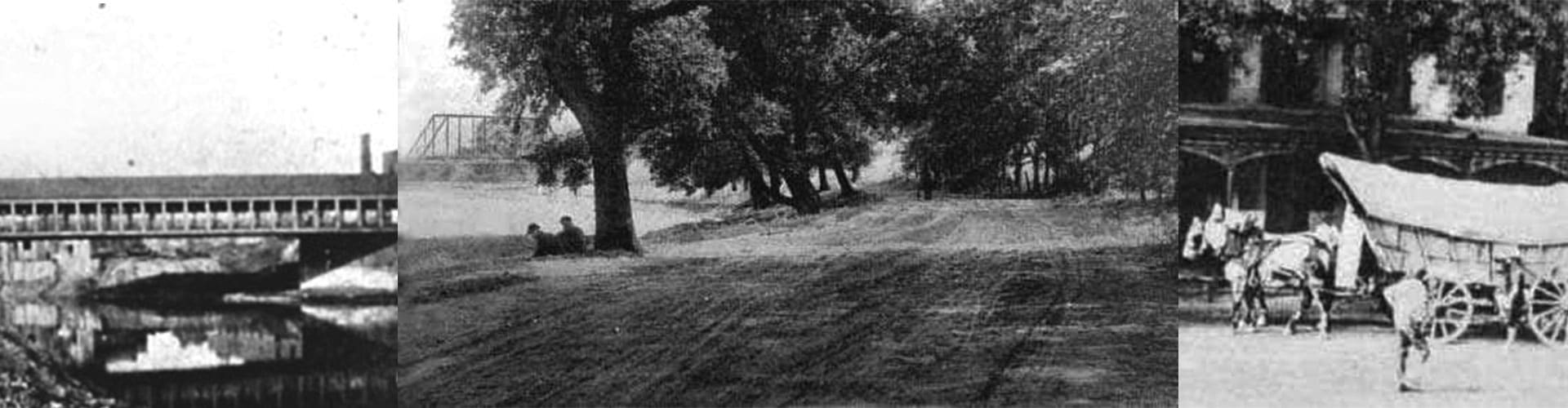
The start of the “Auto Age” brought about a renewed effort to improve the area’s transportation infrastructure. The introduction of asphalt and concrete pavements finally provided a lasting solution to the problem of muddy and rut-filled streets.

During the Great Depression, the Federal Works Progress Administration, Public Works Administration, and Civilian Conservation Corps put thousands of unemployed Ohioans back to work building roads, bridges, drainage, and landscape infrastructure. The average annual application of hot mix asphalt on the state’s thoroughfares rose more than 1,000 percent from 19,400 tons in 1929 to 210,000 tons by 1940.

Amidst this prolific period of construction, the Ohio Legislature officially redesignated the position of “County Surveyor” to that of “County Engineer,” in 1935, to officially provide for both the surveying and highway engineering needs of the state’s evolving counties. Only those who hold both an Ohio Professional Engineers (P.E.) and Professional Surveyors (P.S.) license may qualify for the publically elected office. Past Franklin County Surveyors and Engineers (link within site)