

Franklin County Engineer Facebook Feed

Franklin County Engineer

As a local public works agency headquartered in Columbus, Ohio, the Franklin County Engineer's Office is responsible for the maintenance and construction of 271 miles of county roadway and 351 county bridges, as well as upkeep of all county ditches, drains, retention basins, and other storm water facilities within the right-of-way of county roads in unincorporated areas. To meet the continuing development and infrastructure needs of Franklin County, the Engineer's Office utilizes the latest technologies for determining and maintaining roadway centerlines and boundaries; retracing and setting new monuments for original public land surveys; preparing geographic information system mapping for real estate tax assessments; and establishing precise countywide horizontal and vertical control to maintain uniformity in construction, surveying, and mapping.
Franklin County Engineer
Happy Birthday, Franklin County! Established on April 30, 1803, Franklin County has grown into a vibrant community built on progress, service, and connection. We’re proud to help support the roads, bridges, and infrastructure that keep our county moving each day. Here’s to 223 years of history, and an even brighter future ahead!
Franklin County Engineer
#TeamFCEO is proud to partner with MurphyEpson on the creation of our 2025 Annual Report. Together, we worked to tell the story of the people, projects, and public service that keep Franklin County moving. Thank you to the MurphyEpson team for helping bring this important publication to life. View the report on our website at the following link: https://franklincountyengineer.org/Assets/annual_reports/2025%20Annual%20Report.pdf
Franklin County Engineer
Hess Boulevard, between Chambers Road and West 8th Avenue, is closed for storm sewer installation. The closure will last approximately two (2) days, weather permitting.
Franklin County Engineer
Rain may have been in the forecast, but it did not stop the successful 2nd Annual Spring Training Days at FCEO. Thank you to our outstanding presenters from FCEO, fellow government agencies, and community partners who shared their time, knowledge, and expertise with our team. Investing in learning, collaboration, and professional growth helps keep us strong as an organization and better prepared to serve the public.
Franklin County Engineer
Notice to Contractors: We are accepting bids on the Franklin County Engineer’s Office 2026 General Bridge Maintenance Contract. Visit: https://www.bidexpress.com/solicitations for more information.
Franklin County Engineer
Rohr Road, between Bixby Road and Creekside Parkway, will be closed beginning Monday, May 4, 2026, for road widening work. The closure will last approximately sixty (60) days, weather permitting.
Franklin County Engineer's Office
970 DUBLIN ROAD
COLUMBUS, OHIO 43215
(614) 525-3030
fracoeng@franklincountyengineer.org

Follow Us

Top
 

Highway Chronicle Chapter 3

Highway Chronicle Chapter 3

National Road is First Cross Country Route
road

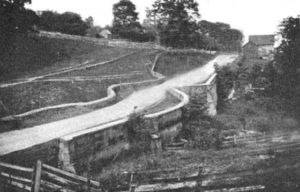
Declaring the importance of highways to the growth and vibrancy of the nation, President Jefferson signed legislation in 1806 to build the “National Road” that would carry settlers and commerce from Cumberland, Maryland to the American West. Ground was broken in 1811, and the section from Zanesville to Columbus was completed in 1833 at a cost of $320,000.

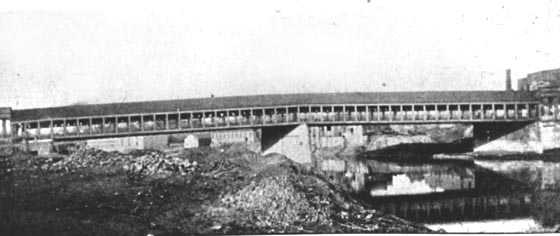
The route through Franklin County followed today’s East Main Street west to High Street, and north to Broad Street (U.S. Route 40) where it crossed the Scioto River on a newly constructed 340-foot long Town’s Lattice Truss covered bridge. The approximately 20 to 120-foot wide thoroughfare was praised for its macadam surface developed by Scottish Engineer John MacAdam (1756-1836).

A macadamized road featured a 12 to 18-inch deep base of large stone, a middle layer of smaller stone, and a top layer of compacted gravel and dirt that was gradually sloped for drainage into side ditches.

Toll gates were located every 10 miles to help finance construction and maintenance costs. A horseback rider paid six cents; stagecoaches drawn by two horses paid 12 cents; wagons drawn by a single horse or ox paid five cents; and those drawn by two animals paid 10 cents.

Beyond Columbus, National Road construction would continue seven more years through western Ohio, Indiana, and Illinois where it was completed at Vandalia in 1840.

To learn more about the National Road in Ohio, please visit the Ohio National Road Association web site.
bridge