

Franklin County Engineer Facebook Feed

Franklin County Engineer

As a local public works agency headquartered in Columbus, Ohio, the Franklin County Engineer's Office is responsible for the maintenance and construction of 271 miles of county roadway and 351 county bridges, as well as upkeep of all county ditches, drains, retention basins, and other storm water facilities within the right-of-way of county roads in unincorporated areas. To meet the continuing development and infrastructure needs of Franklin County, the Engineer's Office utilizes the latest technologies for determining and maintaining roadway centerlines and boundaries; retracing and setting new monuments for original public land surveys; preparing geographic information system mapping for real estate tax assessments; and establishing precise countywide horizontal and vertical control to maintain uniformity in construction, surveying, and mapping.
Franklin County Engineer
Beach Road, between Amity Road and Plain City-Georgesville Road, will be closed beginning Monday, August 31, 2026, for bridge rehabilitation work. The closure will last approximately five (5) days, weather permitting.
Franklin County Engineer
Cooke Road improvements are moving forward! Crews are making progress on storm sewer, roadway construction and new curb and gutter from Karl Road to Cleveland Avenue. Beginning Sept. 14, one westbound lane will reopen between Karl Road and Dresden Street, weather permitting.
Franklin County Engineer
Notice to Contractors: We are accepting bids on the Kropp Road Drainage Outlet Improvement Part 2 Improvements Project. Visit: https://www.bidexpress.com/solicitations for more information.
Franklin County Engineer
Cooke Road, between Dresden Street and Walford Street, is closed for roadway improvements and the addition of pedestrian facilities. The closure will last approximately seventy-five (75) days, weather permitting.
Franklin County Engineer
We had a fantastic time at New Albany’s Touch-A-Truck event! Families stopped by to explore our snowplow truck, get a closer look at the equipment we use to keep our roadways safe, and pick up some fun giveaways. The day was filled with lots of excitement, curious kids, and wonderful conversations with the community. Thank you to the New Albany, Ohio Government for hosting such a fun and engaging event!
Franklin County Engineer
Hardy Parkway Street, south of Frank Road, is now closed for roadway improvements. The road is expected to remain closed for approximately 30 days, weather permitting.
Franklin County Engineer's Office
970 DUBLIN ROAD
COLUMBUS, OHIO 43215
(614) 525-3030
fracoeng@franklincountyengineer.org

Follow Us

Top
 

Highway Chronicle Chapter 9

Highway Chronicle Chapter 9

Auto Age Arrives, Ohio Highway Department Established
HC9-2

I am text block. Click edit button to change this text. Lorem ipsum dolor sit amet, consectetur adipiscing elit. Ut elit tellus, luctus nec ullamcorper mattis, pulvinar dapibus leo.The Auto Age began in Franklin County in September 1899 when businessman Campbell T. Chittenden bought the region’s first “horseless carriage” from the Winton Motor Carriage Company in Cleveland. The $1,000 gas-powered vehicle could reach a maximum speed of 33 m.p.h.

Two months later, inventor Perry Okey built the first automobile in Columbus and “motored” around the county to much acclaim.

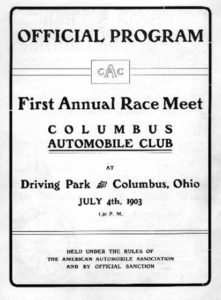
In 1903, 16 horseless carriage owners joined together to form the Columbus Automobile Club, and more than 10,000 spectators gathered at the Columbus Driving Park, on July 4, to witness daredevil Barney Oldfield break the automobile speed record by hitting 70 mph behind the wheel of a Peerless Green Dragon.

To help meet the challenges of growing automobile travel, the legislature established the Ohio Highway Department in 1905 and Ohio Bureau of Motor Vehicles in 1906.

The highway department initially designated county surveyors to be their representatives in identifying and repairing roadway problems. They also oversaw the distribution of state funding derived from registration fees, first collected in 1908, and the two-cent per gallon gas tax initiated in 1925.

By 1930, there were 107,000 automobiles registered in Franklin County that accentuated the need for dramatically improved travel. At the time, there were still 183 miles of earthen roads and 386 miles of macadam roads that were dusty rut filled thoroughfares that often turned to mud.

ticket